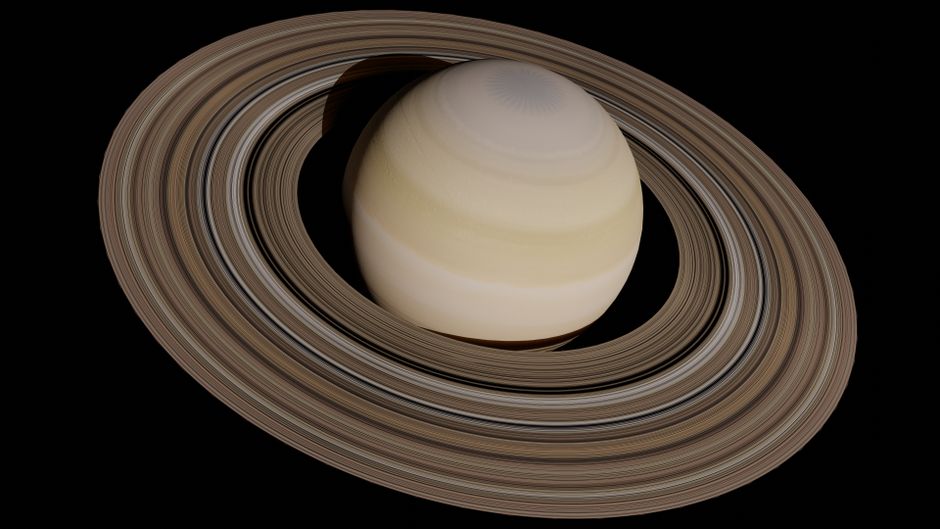
In an extraordinary convergence of amateur passion and professional astronomy, a retired Australian miner has contributed a significant finding to planetary science after spotting a ten-sided storm system swirling around Saturn's south pole.
The discovery was made by Ian Griffin, who spent years observing Saturn from his home in Queensland using a relatively small reflector telescope. His careful records of atmospheric features along the planet's southern hemisphere added crucial ground-based data that supports decades-old observations from NASA's Hubble Space Telescope.
The phenomenon, known as a decagon, is a rare and bizarre geometric formation only visible near Saturn's poles. While Hubble first captured evidence of the ten-sided jet stream pattern at Saturn's north pole in 2012, the southern counterpart has been far more elusive. Griffin's sustained observations helped confirm its existence at the south pole as well, marking the first time this unusual atmospheric structure has been identified on both hemispheres of the gas giant.
Scientists describe the decagon as a standing atmospheric wave that spans multiple layers of Saturn's atmosphere. The wave is intimately connected to powerful jet streams that circle the planet, and it stretches across enormous distances — roughly equivalent to the width of Earth itself. Understanding how these waves form and persist gives researchers vital clues about the internal mechanics of gas giants, particularly how energy moves through their thick, turbulent atmospheres.
Griffin's contribution highlights the growing importance of citizen science in astronomical research. While professional observatories and space telescopes provide the bulk of deep-space data, amateur astronomers with long-term, systematic observation programs can fill critical gaps, especially when tracking changes over many years.
The discovery has been shared with planetary scientists at institutions including NASA's Jet Propulsion Laboratory, where researchers are now incorporating the ground-based data into models of Saturn's atmospheric dynamics.