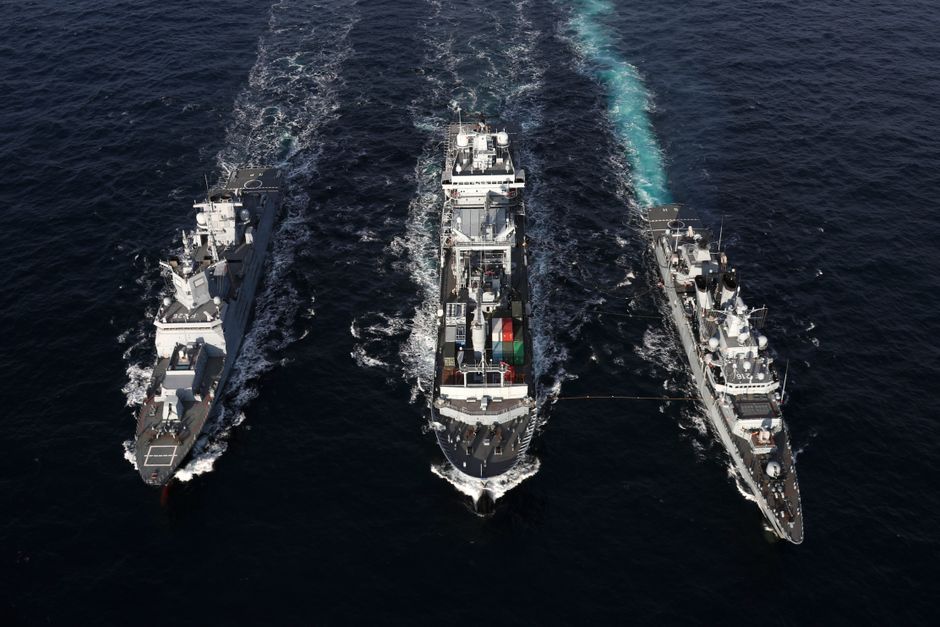
The collision between Indian and Pakistani warships off the Arabian Sea has reignited discussion around the growing asymmetry in naval capabilities across the India–Pakistan maritime boundary. While the incident itself remains under official review, defence analysts say it has laid bare a structural reality that policymakers on both sides have long acknowledged: India's maritime force has expanded at a pace far outstripping Pakistan's over the past two decades.
Indian naval forces now operate a full aircraft carrier, multiple diesel-electric submarines, guided-missile destroyers and frigates built under indigenisation programmes alongside imported platforms from Russia, France, and Israel. Pakistan, by contrast, maintains a modest fleet anchored around a handful of frigates, corvettes, and a small submarine brigade, with its major surface combatants procured mainly from Turkey and China.
Maritime experts point out that the gap is not merely quantitative but qualitative. India's integrated air-defence networks, carrier-based aviation, and long-range maritime-reconnaissance assets give it the ability to project power well into the western Indian Ocean — a zone that Pakistan's navy can largely monitor but not dominate. This capability differential has shaped strategic calculations for years, particularly during periods of heightened tension along the Line of Control, when sea-denial threats from Karachi become a central concern for New Delhi.
The collision, details of which are being withheld for operational security reasons, appears to have occurred during routine surveillance activity rather than any provocative manoeuvre, according to preliminary accounts. Both navies have stated they are examining the circumstances to determine fault and safety lapses.
Observers note that incidents at sea between nuclear-armed neighbours carry outsized risks. Even minor collisions can spiral quickly if interpreted through the lens of adversarial intent. Defence analysts argue that stronger naval communication protocols and established hotlines between Mumbai and Karachi could reduce the chance that a navigational accident escalates into a broader crisis.
For Pakistan, the episode underscores continued pressure to modernise a fleet that faces increasing difficulty keeping pace with India's growing blue-water ambitions, especially as New Delhi deepens maritime partnerships with the United States, Japan, and France in the Indo-Pacific.