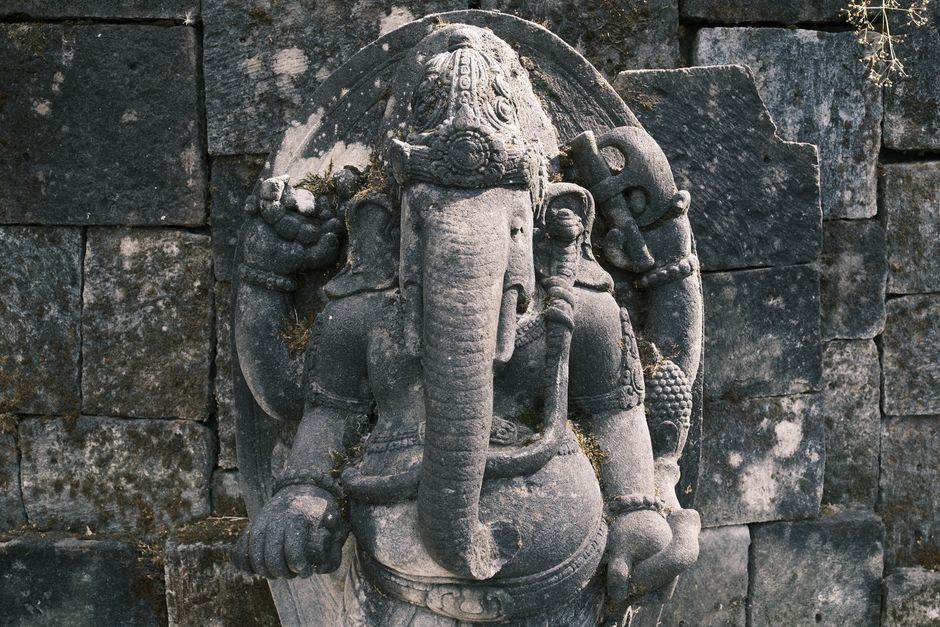
The image of Lord Ganesha — elephant-headed deity with a single broken tusk — is instantly recognisable across India and beyond. Yet few devotees pause to consider that the reason for his残缺 tusk is not settled in a single authoritative version. Hindu mythology preserves at least three distinct narratives explaining how Ganesha came to lose one of his two tusks, and these stories come from different scriptural traditions, sometimes depicting him in very different roles.
The most widely circulated account comes from the Maha Bhagavata Purana. According to this version, Ganesha served as the scribe who recorded the epic Mahabharata as sage Vyasa dictated it. The writing began without interruption and the reed pen ran out of ink before the massive composition could be completed. In a moment of quick thinking, Ganesha broke off one of his own tusks and used it as a writing instrument, continuing the narration through the night until the entire text was preserved. This tale elevates Ganesha not only as the remover of obstacles but also as the god of learning and literature.
A second tradition found in several Puranic sources presents a more martial scene. Here, Ganesha is stationed as a loyal guard outside his father Shiva's quarters. When Parvati, unaware that her son has been set to block the door, sends him away, a furious Shiva confronts the young deity and beheads him. In another variant of this confrontation, Ganesha breaks his own tusk during the clash, offering it as a symbolic gesture of respect or sacrifice toward his father. This story emphasises duty, filial devotion, and the complex dynamics within the divine family.
A third, less commonly cited account traces the injury back to an encounter with the demon Andhaka. In this narrative, Ganesha battles the demon, who was born from a drop of Shiva's sweat, and during the struggle his tusk is shattered. This version appears in regional retellings and certain oral traditions rather than in a single central scripture.
Scholars note that the plurality of these accounts reflects a broader characteristic of Hindu textual culture, where multiple sometimes contradictory versions coexist without demanding exclusive adherence. The variations persist because they serve different devotional and moral purposes rather than competing for historical fact.
Across all three stories, the broken tusk acquires layered meaning. It symbolises sacrifice — whether for knowledge, for family duty, or in battle. It represents adaptability and resourcefulness under pressure. And it reinforces Ganesha's identity as a deity who transforms personal loss into creative achievement.