When most people picture a building, they imagine walls rising from flat ground and a roof sitting comfortably on top. But around the world, a handful of structures are turning that expectation on its head—literally and figuratively.
These five unconventional buildings, each located in a different country, have become major tourist attractions precisely because they refuse to follow architectural rules anyone would recognize.
In Sweden, nestled deep inside a towering pine forest, sits a treehouse hotel designed to look as though it grew organically from the branches themselves. The structure blends timber, glass, and natural materials so seamlessly that from a distance, it appears almost invisible among the canopy. Created by Swedish designer Jonas Hallén, the concept was born from a desire to make guests feel as if they were sleeping inside a living forest. Inside, the rooms are fitted with rustic but refined furnishings, panoramic windows framing the treetops, and even a small private terrace accessible only by rope bridge. Since opening, it has drawn visitors from Europe and beyond who want an overnight stay that feels more like a fairytale than a standard hotel booking.
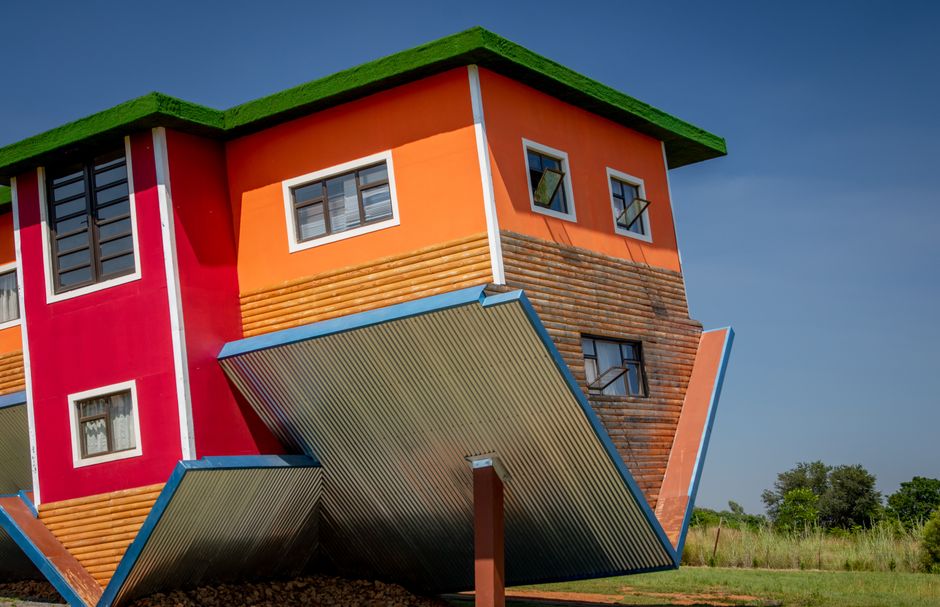
Perhaps the most talked-about entry on the list is the Upside-Down House in southern Poland. Built originally as a private residence and later converted into a museum and restaurant, the entire interior is installed exactly as one might expect—but then flipped 180 degrees. Furniture is bolted to the ceiling, cars are parked on rooftops, and people walk on what looks like the underside of a roof. Photographers flock to the site, and the disorienting experience has made it one of the region's most visited quirky landmarks. Local officials say tourism revenue from the attraction has boosted nearby businesses significantly.
In another corner of Europe, a residential complex in Switzerland appears to be carved directly out of massive, pale limestone boulders. Designed to merge with the alpine terrain rather than impose upon it, the building uses organic curves, irregular openings, and natural stone facades to give the impression that someone chipped away at a mountain to reveal a home hidden inside. Architects behind the project say sustainability was central to the design, with the thick stone walls providing natural insulation that reduces energy consumption year-round.
Elsewhere in Asia, a compact capsule-style hotel in Japan offers an entirely different kind of unconventional experience. Though capsule hotels have existed for decades, a new iteration in Tokyo features pods arranged in stacked spiral formations with LED-lit corridors and shared rooftop gardens, creating a futuristic, almost sci-fi atmosphere. The design responds to dense urban living conditions and rising accommodation costs, offering budget travelers a novelty experience that is as functional as it is memorable.
Finally, a desert retreat in the United Arab Emirates has captured attention for its tent-inspired architecture. Constructed with lightweight, breathable fabrics stretched over curved wooden frames, the temporary-looking structures are actually permanent installations equipped with modern climate control. The design draws on traditional Bedouin shelter aesthetics while incorporating solar panels and passive cooling systems, making it both culturally resonant and environmentally conscious.
Architectural critics note that these projects share a common thread: they prioritize experience over convention. Visitors do not come simply to see a building—they come to step inside an idea that challenges how space, form, and function can interact. Tourism boards in host countries have quickly recognized the economic potential, marketing these sites as must-see destinations that put smaller towns and lesser-known regions on the global travel map.


